Benjamin L. Cardin                         Mark Morial                           Marion Wright Edelman


Benjamin L. Cardin, United States Senator for Maryland

Earth Day 2012: Protecting the Environment for Future Generations


Forty-two years ago, the late Wisconsin Senator Gaylord Nelson had a vision of a world in which the environment was paramount. His vision led to the establishment of Earth Day -- April 22 -- a day in which we celebrate our planet and the environment that sustains us.

On Earth Day we recommit ourselves to protecting the air we breathe, the water we drink and the land that nurtures us.  Our planet has been entrusted to us for future generations, but today too many people suffer the consequences of an environment at risk.  We see too many children suffering from asthma, we see too many Americans sickened by environmental pollutants and too many people worried about the safety of their drinking  water.

We have -- and we can -- continue to make progress thanks to strong environmental laws that have helped us reduce air pollution and clean up polluted streams and rivers. The Environmental Protection Agency estimates that the Clean Air Act has prevented 160,000 premature deaths and 1.7 million asthma attacks in 2010 alone. Since the passage of the Clean Water Act in 1972, more than one billion pounds per year of toxic pollutants have been removed from our nation’s waterways.  As a member of the Environment and Public Works Committee, I am committed to protecting the Chesapeake Bay and to reduce other environmental pollutants that threaten our health and safety.  The bottom line is: I will fight any attempt to roll back environmental protection laws.

I am also encouraged by the growing realization of Americans that a strong environment means a stronger economy and a more secure nation.  We need to create sustainable jobs and that means we need to invest in an economy that’s built on efficiency and sustainability and that will protect our water, air and land.

We also must lessen our dependence on an extremely volatile, unpredictable world oil market.  Developing America’s abundant renewable energy resources is critical for lowering energy costs and for reducing our reliance on foreign energy supplies.  Clean energy jobs are a policy tri-fecta: it’s good for the economy, good for the environment and good for our national security.

As we celebrate Earth Day, we can rise to these challenges, and live up to Senator Nelson’s vision for the planet Earth.  America has an obligation to lead the rest of the world by example, and a strong, sustainable environment is a critical goal for the entire world.  We owe our future generations no less.


TOP OF PAGE 


To Be Equal
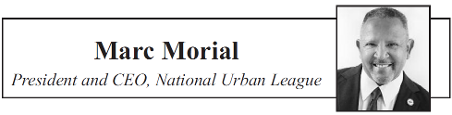
Marc Morial, President and CEO, National Urban League

National Urban League Earns Top Ratings for Management, Accountability


The National Urban League, now in its 102nd year, has played an indispensable role in the  empowerment of African American and working class citizens, while challenging the nation to live up to its promise of liberty and justice for all.  Last week’s arrest of George Zimmerman, a first step towards justice for the family of Trayvon Martin, was a reminder of what we as Americans can achieve when we collectively stand up and speak out for fairness, common sense and the rule of law.  The National Urban League is also lending its voice and expertise to efforts to improve the education of our children, the health of our families, and the economic vitality of our communities.  But even as we celebrate these accomplishments, I am determined that the organization never lose sight of its responsibility to be a good steward of the public’s trust and support.  That is why, as the League prepares for its July 25-28 annual conference in New Orleans, I thought I would take a moment to thank our many supporters and to remind everyone of our unwavering commitment to financial and organizational accountability.  It is a record we can be proud of.  But don’t take my word for it.

Last year, the Chicago Tribune named the National Urban League the top charity serving African Americans.   In addition, Charity Navigator, an independent evaluator of more than 2000 charities, gives the National Urban League four stars, its highest rating.  This rating signifies that the National Urban League exceeds industry standards and outperforms most comparable charities in the area of strong fiscal management. 

CharityWatch, formerly the American Institute of Philanthropy, an organization the New York Times has called, “the pit bull of watchdogs,” also gives the National Urban League its top “A” rating.  The organization explains, “Of the approximately 600 charities currently rated by CharityWatch, only a select number qualify for our listing of Top-Rated charities based on our rigorous analysis.  Groups included on the Top-Rated list generally spend 75% or more of their budgets on programs, spend $25 or less to raise $100 in public support, do not hold excessive assets in reserve, and receive “open book” status for disclosure of basic financial information and documents to CharityWatch.”

The National Urban League is also accredited with the Better Business Bureau, meaning that the organization meets the BBB’s 20 standards for charity accountability.

The ratings of all these independent evaluators give donors and potential donors the information they need to make intelligent giving decisions.  In these tough economic times, charitable organizations are being scrutinized more closely and donors have a right to expect that their contributions are being properly spent.  The National Urban League is pleased that our fiscal soundness and the effective management of our resources has been recognized by these trusted watchdog organizations.  It demonstrates that a donor’s investment in the National Urban League is safe and sound and is being used for the mission-related purposes for which it was intended.  Our commitment to good stewardship and accountability remains strong.  Together, we have a lot of work to do and we are grateful for your continued support.

Top of Page


It is not only what we do, but also what we do not do, for which we are accountable.” 

The great French Playwright, Moliere.


 Child Watch by Marion Wright Edelman

SNAP: Cutting What Works?


This week has been a devastating one for children and the poor. It began with the U.S. Conference of Catholic Bishops urging members of the House of Representatives Agriculture Committee for “moral and human reasons” to “protect programs that serve poor and hungry people over subsidies that assist large and relatively well-off agricultural enterprises.” Despite urgent pleas from a broad spectrum of faith leaders and advocates for the poor, the House committee voted to protect all the agricultural farm subsidies which primarily benefit the most well to do farms and to cut billions of dollars of benefits from programs that feed poor children and their families. The draconian cuts would affect all 46 million people who receive food stamps including 23 million children.

As the Center for Budget and Policy Priorities explains, “No other program under the Committee’s jurisdiction would face any cut under the proposal, despite frequent calls for reform of the nation’s farm subsidies—74 percent of which go to the largest, most profitable farms, according to the Agriculture Department based on 2009 data. These large commercial farms received an average annual government payment of more than $30,000 a year in 2009, while having an average annual household income of over $160,000.” Who do we want our leaders to protect—non-needy farmers or hungry children?

The Supplemental Food and Nutrition Program (SNAP), or food stamps, provides targeted assistance for families when they need help most. Since the beginning of the recession millions of low and middle income parents have lost their jobs and the security of knowing their children would not go to sleep or to school hungry. With record numbers of families living in poverty and food prices increasing more rapidly than in decades, SNAP has been a critical support for millions of children while their jobless parents struggle to get their family finances back on track. A recent study by the Agriculture Department shows how essential the food stamp program is: it reduced the poverty rate by nearly eight percent in 2009, the most recent year in the study.

Hunger and malnutrition have especially devastating consequences for children because their developmental well-being depends on adequate nutrition. Hunger has been linked to low birth weight and birth defects, obesity, mental health problems, oral health problems, and poor educational outcomes. But SNAP makes a difference. The overwhelming majority of SNAP recipients—three quarters—are families with children. SNAP lifted 5.2 million Americans above the poverty line in 2010—more than any other benefit program.

SNAP is also strong economic recovery policy. As the economy struggles, getting food stamps and other payments to low-income families is an effective way to stimulate the economy quickly. Families living paycheck to paycheck spend the money almost immediately on basic necessities, pumping dollars back into the local economy. Just one dollar of SNAP benefits creates a “ripple effect” through the economy, and research shows each $5 of federal SNAP benefits generates nearly twice that amount in economic activity.

Despite its proven success, SNAP remains a consistent target at budget-cutting time. This latest assault by the House committee means two million people would be cut off from food stamps completely and millions more would have reduced benefits. Hundreds of thousands of children would lose free school meals on top of their SNAP benefits. These additional changes on top of already enacted cuts will increase child and family hunger. The House of Representatives’ new budget—labeled the Ryan budget—for Fiscal Year 2013 would fundamentally change SNAP by converting it into a “block grant” program and cut its funding by $133.5 billion—more than 17 percent—over the next ten years (2013-2022). A block grant would allow states to cap eligibility, create waiting lists, and/or sharply reduce or end benefits for millions of children and families still struggling to recover from the recession. It threatens the program’s ability to respond when the American people need help most. At the exact same time the House was making these decisions, the non-partisan Congressional Budget Office released a new report predicting the need for food stamps would keep growing through 2014 as American families continue to recover from the recession. The impact of more cuts on children and families who now receive a nutritionally adequate diet from SNAP would be devastating. Where is the justice in a vote to protect wealthy farmers over hungry children? Tell your Members of Congress that SNAP needs to be preserved as a lifeline for hungry Americans in hard times. There should be no hungry people—especially children—in rich America.

Marian Wright Edelman is President of the Children's Defense Fund whose Leave No Child Behind® mission is to ensure every child a Healthy Start, a Head Start, a Fair Start, a Safe Start and a Moral Start in life and successful passage to adulthood with the help of caring families and communities. For more information go to www.childrensdefense.org.

Mrs. Edelman's Child Watch Column also appears each week on The Huffington Post.


 Top of Page


Would you like to subscribe?

Please contact our office:

15207 Marlboro Pike
Upper Marlboro, MD 21177

Tel: 301-627-0900
Fax: 301-627-6260


The Prince George's Post is made up of a small staff, including:

Publisher, Legusta Floyd, Sr.

Editor, Legusta Floyd, Sr.

General Manager, Brenda Boice

Legal Advertising Manager, Brenda Boice 

Production, Robin Boerckel

Circulation and Production, Elizabeth Brandenstein

Paper delivery,
James and Betty Murphy

Web Master, Kyler Kamp